

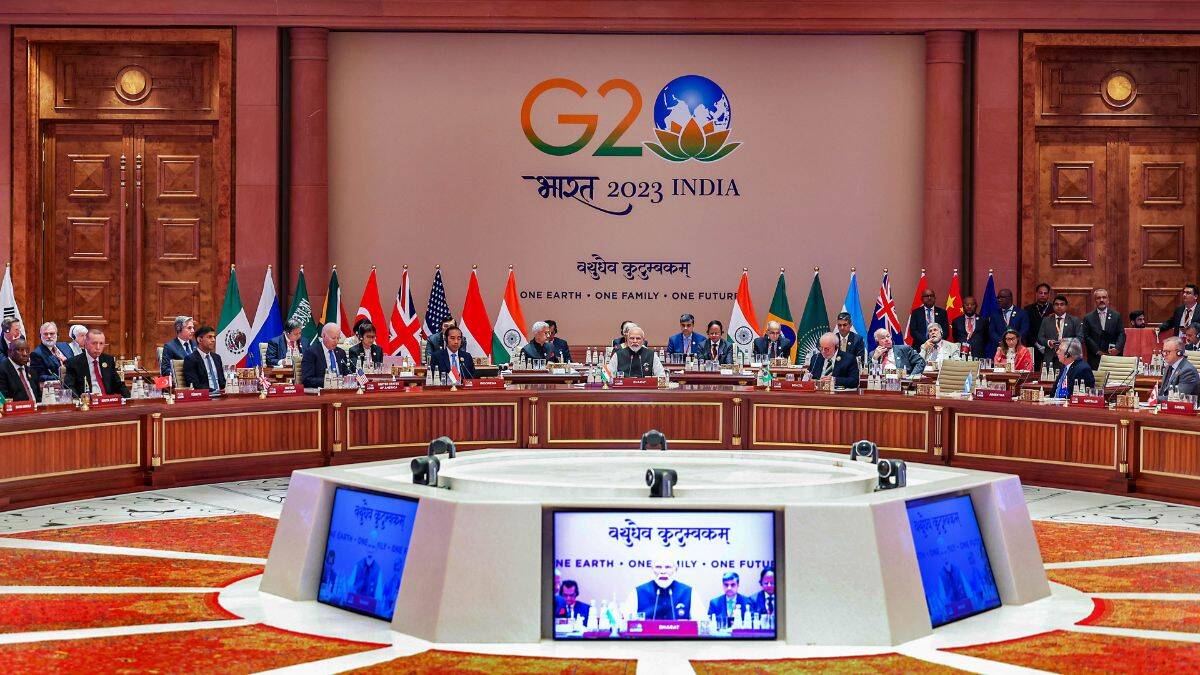
India’s presidency of the 18th Group of 20 Summit (G20 Summit) in 2023 marked a significant milestone in global governance. Under the leadership of Prime Minister Narendra Modi, the New Delhi G20 Leaders Declaration achieved ‘100% consensus,’ addressing critical global issues, fostering diplomatic relations, and propelling India onto the world stage.
The Road to Consensus:
The New Delhi G20 Leaders Declaration was a product of relentless dedication and diplomacy by four Indian Foreign Services officers: Abhay Thakur, Ashish Sinha, Nagaraj Naidu Kakanur, and Enam Gambhir. These diplomats worked tirelessly, navigating months of negotiations and back-and-forth discussions with member countries. Their determination culminated in a remarkable achievement—a communique with complete consensus.
- Enam Gambhir, a Joint Secretary in the G20 and a 2005 batch IFS officer, played a pivotal role. Fluent in Spanish, she previously served as a senior advisor on Peace and Security issues at the United Nations General Assembly in New York. Gambhir’s expertise extended to handling complex issues related to Pakistan, Afghanistan, and Iran. Her academic background, which includes two Master’s degrees, one in mathematics from Delhi University and another in international security from the University of Geneva, reflects her multidimensional skills, including poetry in Spanish, English, and Hindi.
- Ashish Sinha, another 2005 batch IFS officer with fluency in Spanish, brought his experience from postings in Madrid, Kathmandu, New York, and Nairobi. In New Delhi, he served in the External Affairs Minister’s office and as a desk officer for Pakistan.
- Abhay Thakur, an Additional Secretary and the No. 2 to India’s G20 Sherpa, Amitabh Kant, is fluent in Russian. His diplomatic career included assignments as India’s envoy to Mauritius and Nigeria, as well as handling Nepal and Bhutan in the Ministry of External Affairs. Thakur’s background also includes time as a director in the External Affairs Minister’s office.
- Nagaraj Naidu Kakanur, fluent in Chinese, serves as a Joint Secretary and led negotiations on paragraphs related to the Ukraine conflict. A member of the 1998 IFS batch, Naidu’s experience encompasses key roles such as Chef de Cabinet to the President of the 76th Session of the United Nations General Assembly. He also managed the MEA’s Economic Diplomacy division and headed the Europe West Division, responsible for relationships with major G7 countries and the European Union.
The Delhi Declaration: Forging Consensus Amid Challenges:
Notably, the negotiations regarding paragraphs related to the Ukraine conflict were entrusted to diplomats Enam Gambhir and Nagaraj Naidu Kakanur. These negotiations faced challenging circumstances when the consensus on Ukraine broke down in December, a month following the G20 Summit in Bali.
To navigate this crisis, the Indian delegation strategized by enlisting the support of Brazil and South Africa, both of which were slated to host future G20 summits. Their shared identity as developing countries lent credibility to their arguments. After months of intensive negotiations and five sleepless nights, they reached a consensus between the G7 and the Russia-China bloc. Key to this resolution were phone calls between Prime Minister Modi and Russian President Vladimir Putin, as well as a bilateral meeting with US President Joe Biden.
A Global Platform for Unity and Progress:
The G20 Summit in 2023 provided a platform for leaders from around the world to discuss and address critical global challenges. Prime Minister Modi’s proposal for a virtual session of the G20 in November to review the decisions made during the leaders’ summit further emphasized the commitment to collective progress.
In addition to the diplomatic achievements, the summit showcased India’s ability to host major international events. Prime Minister Modi’s visits to various pavilions, including the Digital India Pavilion, demonstrated India’s commitment to innovation and technology.
Strengthening International Relations:
The G20 Summit was not just about consensus on global issues; it also provided an opportunity for bilateral meetings and discussions. Prime Minister Modi held talks with several world leaders, including German Chancellor Olaf Scholz and Brazilian President Luiz Inácio Lula da Silva. The discussions emphasized the importance of India’s partnerships on the global stage.
Addressing Global Concerns:
During the summit, leaders discussed a wide range of topics, including climate change, the Ukraine conflict, and international trade. French President Emmanuel Macron underscored the G20’s commitment to upholding principles of sovereignty and territorial integrity of states, particularly in reference to the Ukraine conflict.
Promoting Global Unity:
The summit also highlighted the importance of unity and cooperation in addressing global challenges. Japanese Prime Minister Kishida expressed concern about Russia’s aggression against Ukraine and the potential impact on the foundation of the G20.
A Successful G20 Presidency:
In the eyes of global experts, the G20 Summit under India’s presidency was a significant step forward in global governance. John Kirton, the Director of the G20 Research Group, praised the summit as a breakthrough, emphasizing India’s role in consolidating positions among Global South countries.
Confronting Extremism:
On the sidelines of the summit, Prime Minister Modi had a crucial meeting with Canadian Prime Minister Trudeau. During the meeting, he conveyed India’s strong concerns regarding anti-India activities of extremist elements in Canada. These elements were found to promote secessionism, incite violence against Indian diplomats, damage diplomatic premises, and threaten the Indian community and their places of worship. Prime Minister Modi stressed the importance of a relationship built on mutual respect and trust, rooted in shared democratic values and respect for the rule of law.
Conclusion:
India’s G20 presidency in 2023 left an indelible mark on global diplomacy. Achieving complete consensus on critical issues, hosting successful bilateral meetings, and addressing concerns such as extremism underscored India’s growing influence on the world stage. The summit not only strengthened India’s international relations but also highlighted the nation’s commitment to addressing global challenges and fostering unity among nations.
Regards- Team sarkarikhabrein.in